
USE CASE ENGINEERING & SIEM TUNING: OPTIMIZING THE SIGNAL-TO-NOISE RATIO
Introduction: Beyond the Out-of-the-Box Fallacy
In the early days of security operations, success was often measured by the number of active correlation rules in a SIEM. Today, that approach is a liability. Sophisticated threat actors operate in the “gray space” of legitimate administrative activity, easily bypassing static, vendor-default rules. Use Case Engineering & SIEM Tuning is the specialized discipline of transforming a generic log repository into a precision-guided detection engine. It is the process of ensuring that every alert generated is not just a technical anomaly, but a clear indicator of a business-relevant threat.
What This Service Means in Modern SOC
Modern Use Case Engineering represents the move from “Static Alerts” to Detection Engineering. In a modern SOC, this service acts as the intelligence layer that translates high-level threat models into technical logic. It means moving away from a “set-and-forget” mentality and adopting a continuous lifecycle of development, testing, and refinement. It is the mechanism that aligns your security telemetry with the specific risks of your industry, infrastructure, and organizational behavior, ensuring your analysts focus on “true positives” rather than “alert noise.”
Key Components / Capabilities
A high-fidelity detection engineering capability relies on several core architectural and logical pillars:
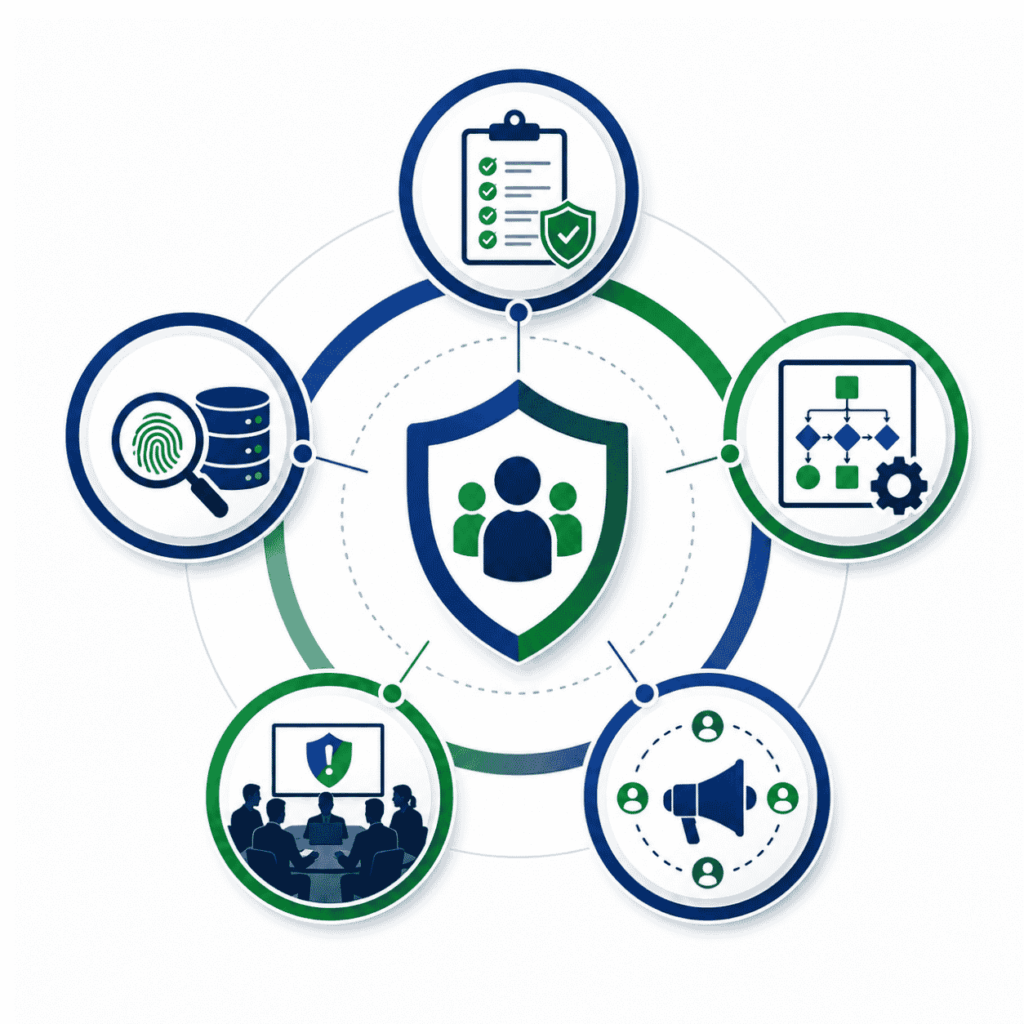
- Threat Modeling & Risk Alignment: Mapping detection logic to specific business risks and adversary tactics relevant to the organization’s vertical.
- Logic Development & Version Control: Writing complex correlation rules, behavioral models, and ML-based detections using a structured, code-like approach (Detection-as-Code).
- False Positive Suppression & Tuning: The systematic identification and exclusion of benign environmental noise to prevent "Alert Fatigue."
- Log Fidelity & Parsing Validation: Ensuring that the raw data being fed into the use case is accurately parsed and normalized to prevent logic failure.
- Testing & Simulation (Purple Teaming): Utilizing breach and attack simulation (BAS) to verify that a use case actually triggers when an adversary technique is executed.
How It Works (Process-Level Explanation)
The engineering and tuning lifecycle is a circular, data-driven process:
Phase 1
Identification & Prioritization
Defining a new use case based on threat intelligence, recent incidents, or gaps identified in the MITRE ATT&CK matrix.
Phase 2
Logic Design & Data Requirement
Determining which logs are required and writing the initial correlation logic or behavioral threshold.
Phase 3
Continuous Review & Retirement
Quarterly audits of rule performance to either tune out new noise or retire rules that are no longer effective against current threats.
Phase 4
Backtesting & Shadow Mode
Running the new rule against historical data or in a “silent” mode to evaluate the volume of alerts and the accuracy of the signal.
Phase 5
Production & Orchestration:
Moving the rule into active monitoring and integrating it with SOAR playbooks for automated triage and response.
Business Value & Use Cases
Investing in detection engineering provides a direct impact on SOC ROI:
Drastic Reduction in Alert Fatigue:
By filtering out benign activity, analysts can focus their energy on high-criticality threats, improving morale and retention.
Improved Mean Time to Acknowledge (MTTA)
High-fidelity alerts reduce the time wasted on “ghost chasing,” allowing for faster identification of actual breaches
Maximizing SIEM ROI
Ensuring that your investment in advanced SIEM deployment strategies delivers actual security outcomes rather than just storage costs.
Agility Against Zero-Days
The ability to rapidly develop and deploy custom detection logic when new vulnerabilities or exploit techniques are discovered.
How to Evaluate Vendors / Solutions
CISOs must evaluate detection engineering partners or internal capabilities based on:
Logic Transparency
Does the provider allow you to see and own the code behind the use cases? Avoid "black box" providers where you cannot audit the logic.
Mapping to MITRE ATT&CK:
How comprehensively does the use case library cover the tactics and techniques relevant to your threat profile?
Integration with MDR:
How well does the tuning logic feed into your broader managed detection and response capabilities?
Tuning Frequency:
What is the operational cadence for reviewing and updating existing rules? Static rules are dead rules.
Simulation Capabilities:
Can the vendor prove the effectiveness of a rule through actual attack simulation during the onboarding phase?
Common Challenges & Pitfalls
The Quantity over Quality Trap
Measuring SOC success by the number of alerts generated rather than the accuracy of those alerts.
Ignoring the Normal Baseline
Developing logic without understanding the unique administrative “white noise” of the client environment.

Broken Data Pipelines:
Failing to recognize that a use case is “blind” because an upstream log source has changed its format or stopped sending data.
Siloed Engineering:
Building detection logic without input from the incident responders who have to investigate the resulting alerts.
Maturity Model / Best Practices
01
Level 1 (Basic):
Reliance on vendor-default rules; minimal tuning; high false-positive rates; reactive alert management.
02
Level 2 (Developing):
nitial mapping to MITRE; basic custom rule creation; periodic tuning based on major incidents.
03
Level 3 (Advanced)
Structured “Detection-as-Code” approach; integration with SOAR; continuous purple team validation and testing.
04
Level 4 (Optimized):
Predictive behavioral modeling; automated tuning; full alignment with business risk and proactive threat hunting.
How It Fits Into
Broader SOC Strategy
Use Case Engineering is the “Logic Layer” of the SOC. It sits between the raw data of SIEM Management and the decisive action of Incident Response. Without precise engineering, the SIEM is just a data lake, and the IR team is just a reactive fire department. Proper tuning ensures that the entire security stack operates as a cohesive, proactive defense system.
Advisory Note
SOCExpert.ae acts as your strategic quality controller. We do not sell SIEM software; instead, we help you audit your current use case library, identify visibility gaps, and provide the technical oversight to ensure your service providers are delivering high-fidelity signals. We ensure your detection logic is engineered for your risk, not just “installed.”
We ensure your strategy belongs to you, not your vendors.
Conclusion: The Future of Strategic Defense
The future of detection engineering lies in “Autonomous Tuning” and AI-assisted logic generation. As attack surfaces expand, the speed of human engineering must be augmented by machines that can recognize and suppress new noise patterns in real-time. Organizations that master the lifecycle of engineering and tuning today will be the most resilient against the AI-driven threats of tomorrow.