
MANAGED SOC SERVICES: A STRATEGIC CO-MANAGEMENT FRAMEWORK FOR THE MODERN ENTERPRISE
Introduction: Contextualizing Managed Security Operations
In the current threat landscape, the binary choice between a fully in-house Security Operations Center (SOC) and a fully outsourced model is no longer sufficient. Enterprise security leaders in the UAE and globally are facing a “perfect storm” of hyper-connectivity, escalating regulatory pressures, and a critical shortage of specialized cybersecurity talent. Managed SOC Services have evolved to address this gap, offering a collaborative bridge that combines the agility of internal business context with the scale and specialized expertise of a global security provider. This subpage explores the strategic nuances of Managed SOC, moving beyond simple alert monitoring to a model of shared resilience.
What This Service Means in Modern SOC
Modern Managed SOC is defined by “Co-management.” It is not a “hands-off” outsourcing arrangement where security is treated as a black box. Instead, it is a strategic partnership where the provider manages the heavy lifting of the security stack—often including the SIEM, EDR, and NDR—while the client retains full visibility and ownership of the underlying data. This model is particularly critical for organizations that have already invested in security infrastructure but struggle to operationalize it effectively. It represents a shift from “Monitoring as a Service” to “Detection Engineering as a Partnership.”

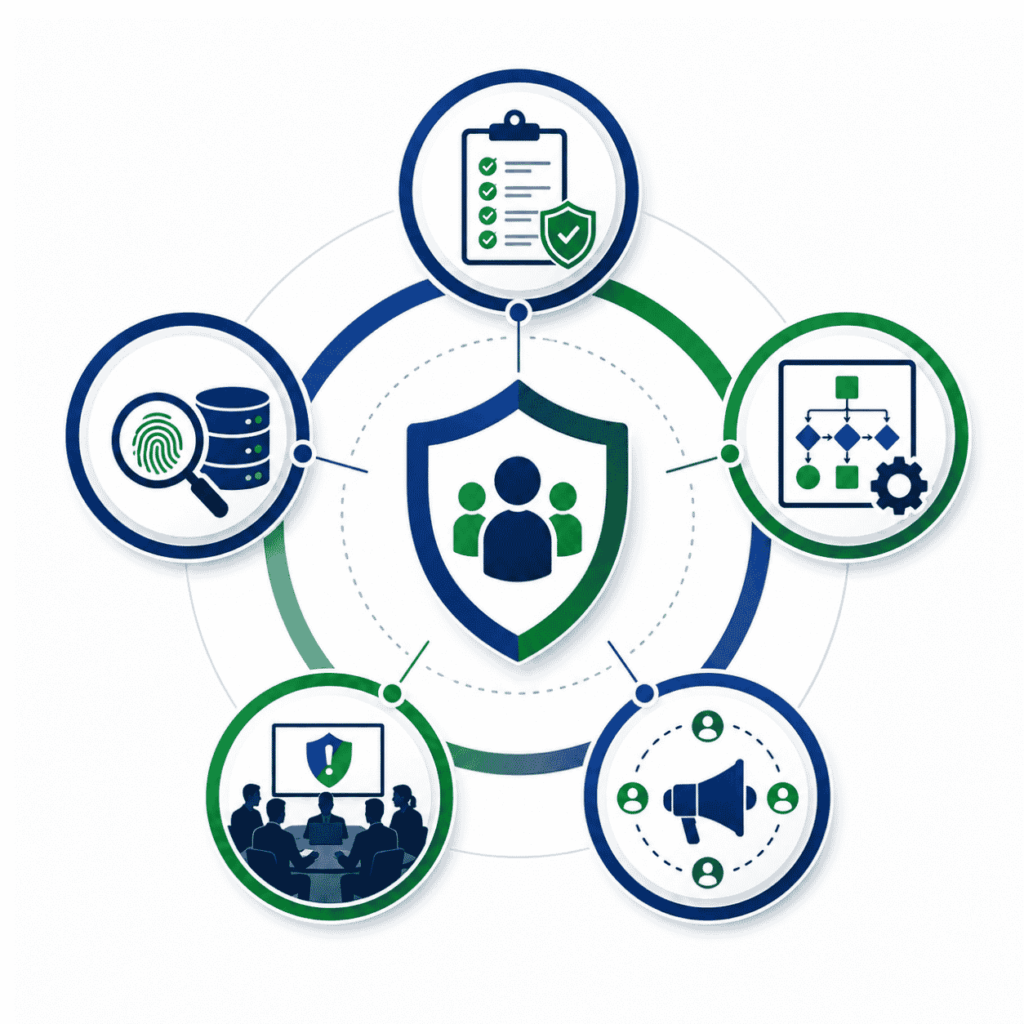
Key Components / Capabilities
A comprehensive Managed SOC service must offer capabilities that extend across the entire threat lifecycle:
- 24/7/365 Continuous Vigilance: Round-the-clock monitoring by Tier 1 and Tier 2 analysts to ensure no critical anomaly is missed, regardless of the time zone.
- Managed Detection and Response (MDR): Proactive hunting for threats that bypass automated controls, utilizing managed detection and response capabilities to reduce dwell time.
- Co-Managed SIEM & Log Management: Expert administration of the SIEM platform, including advanced SIEM deployment strategies to ensure high-fidelity data ingestion.
- Vulnerability Contextualization: Correlating detected threats with known environmental vulnerabilities to prioritize high-risk incidents.
- Custom Threat Intelligence Fusion: Integrating global threat feeds with industry-specific indicators relevant to the GCC and UAE markets.
How It Works (Process-Level Explanation)
The operational cadence of a Managed SOC follows a circular, iterative process designed for continuous improvement:
Phase 1
Environment Baselining:
The provider conducts deep discovery to understand the “normal” state of the network, critical assets, and high-value users.
Phase 2
Engineering & Integration
Deployment of sensors and log collectors, followed by the configuration of detection rules tailored to the client’s specific business logic.
Phase 3
Triage & Analysis
Inbound alerts are filtered through automated playbooks and human analysis to strip away false positives and enrich true positives with business context.
Phase 4
Escalation & Containment
Verified threats are escalated to the client with clear remediation instructions or contained automatically via integrated SOAR tools.
Phase 5
Post-Incident Review
Every major alert triggers a review to update detection logic and improve the overall security posture.
Business Value & Use Cases
For the CISO, the value of Managed SOC is measured in risk reduction and operational efficiency:
Access to Specialized Talent
Instantly gain access to security architects, malware researchers, and forensic investigators without the recruitment overhead.
Operational Agility
Scale security operations up or down in alignment with business growth or mergers and acquisitions.
Regulatory Alignmen
Facilitate compliance with local standards such as NESA, ISR, and UAE IA by providing documented audit trails of security monitoring.
Tool Optimization
Maximise the ROI of existing security investments by having experts tune and manage the tools 24/7.
How to Evaluate Vendors / Solutions
When evaluating a Managed SOC provider, focus on these five strategic pillars:
The Black Box Test
Do you retain access to your own SIEM and data? A provider should enhance your visibility, not obscure it behind a proprietary portal.
Analyst Quality & Location
Where are the analysts located, and what are their certifications (e.g., GCIH, GCFA)? For UAE entities, local presence and understanding of the regional threat landscape are vital.
Detection Engineering Depth:
Ask for examples of custom use cases they have built for your industry. Avoid providers who only offer "out-of-the-box" vendor rules.
SLA vs. SLO:
Look beyond "uptime" SLAs. Focus on Service Level Objectives (SLOs) for Mean Time to Acknowledge (MTTA) and Mean Time to Contain (MTTC).
Tool Agnosticism
Can they manage your existing stack, or are they forcing you to switch to their preferred (and potentially limited) technology?
Common Challenges & Pitfalls

The Context Gap
Managed providers often lack the “tribal knowledge” of your business. Without regular syncs, they may escalate benign internal activities as threats.

Communication Silos
f the hand-off between the provider and your internal IT team isn’t seamless, remediation will be delayed.

Over-Reliance on Automated Alerts
Many providers rely too heavily on standard vendor alerts, missing sophisticated “living off the land” attacks.
Failure to Review Playbooks
Detection rules and response playbooks must be reviewed quarterly, or they will become obsolete as your infrastructure changes.
Maturity Model / Best Practices
01
Foundation (Tier 1)
Focus on 24/7 monitoring, log centralization, and basic perimeter alerting.
02
Expansion (Tier 2):
Inclusion of EDR/XDR telemetry, custom use-case engineering, and basic threat hunting.
03
Optimization (Tier 3):
Deep integration with Incident Response, automated containment, and industry-specific threat intelligence.
04
Strategic (Tier 4)
Full co-management, continuous purple teaming, and direct alignment with business risk management
How It Fits Into
Broader SOC Strategy
Managed SOC should be viewed as the “Operational Engine” of your security department. By offloading the resource-intensive task of 24/7 monitoring and platform maintenance to a trusted partner, the internal security team can elevate their focus to strategic initiatives like Security Architecture, Risk Governance, and long-term Digital Transformation. It enables a “Hybrid SOC” model that is increasingly becoming the gold standard for enterprise resilience.
Advisory Note
SOCExpert.ae serves as your strategic guide in navigating the complex market of Managed SOC providers. Our role is to act as an independent auditor of your service—we help you define the requirements, select the vendor that truly fits your technical stack, and perform ongoing quality assurance on their detection engineering. We ensure the provider is working for you, not just “managing a tool.”
We ensure your strategy belongs to you, not your vendors.
Conclusion: The Future of Strategic Defense
As the boundary between the “internal network” and the “outside world” continues to vanish, security operations must become more fluid and collaborative. Managed SOC Services represent the future of this collaboration. By combining the scale of a specialized provider with the strategic oversight of an advisory-led approach, enterprises can build a defensive posture that is not just reactive, but resilient and business-aligned.